The Giant Impact Hypothesis and How the Moon Was Born
The Moon is unusually large for a rocky planet's companion, shares Earth's orbital plane, and is remarkably similar in composition to Earth's outer layers. The leading explanation is violent: a Mars-sized body called Theia struck the young Earth.
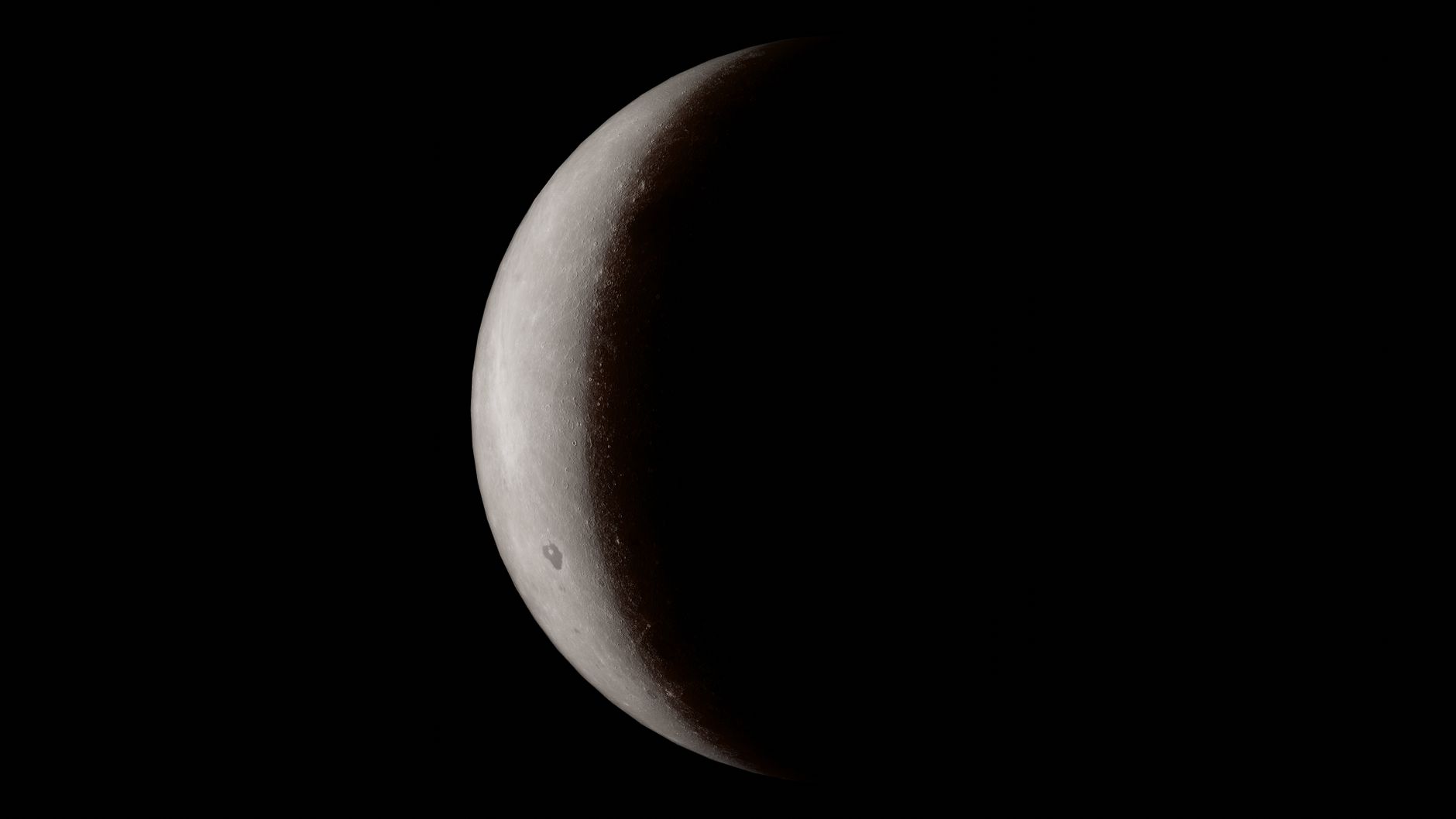
The Moon makes total solar eclipses possible — a coincidence so improbable that it seems designed. The Moon's disc covers the Sun's disc almost exactly from Earth's surface, allowing the solar corona to be observed and the chromosphere's spectrum to be measured. This alignment exists because the Moon is, at this particular moment in cosmic time, roughly 400 times smaller than the Sun and roughly 400 times closer. But beyond this coincidence of apparent sizes, the Moon itself is deeply strange: it is far larger, relative to its planet, than any other moon in the solar system except Pluto's Charon. It is unusually dense (for a moon) yet lighter than Earth. It has almost no iron core despite orbiting an iron-rich planet. And the isotopic composition of Moon rocks brought back by Apollo astronauts almost exactly matches Earth's mantle. These peculiarities demand an explanation. The currently accepted one is extraordinary: roughly 4.5 billion years ago, an object the size of Mars — called Theia — struck the young Earth at an oblique angle, and the debris from that collision coalesced into the Moon.
What happened
The giant impact hypothesis was proposed in 1975 by William Hartmann and Donald Davis, and independently by Alastair Cameron and William Ward. It emerged from attempts to explain the Moon's anomalous properties, particularly its low iron content and its unusually high angular momentum of the Earth-Moon system.
In the Theia collision scenario, a protoplanet roughly the mass of Mars (about 10% of Earth's mass) had formed in a resonant orbit with the proto-Earth and eventually collided with it about 100 million years after the solar system's formation. The impact was not head-on but oblique — more like a glancing blow. The simulations show that such an impact would vaporize the impactor and the Earth's mantle, creating a ring of molten and vaporized rock in orbit around the Earth. This material would cool and accrete into the Moon within a few hundred to a few thousand years.
The model elegantly explains the Moon's low iron content: the iron in Theia sank into Earth's core on impact, while the mantle material from both Earth and Theia — relatively iron-poor — was ejected into orbit. It explains the isotopic similarity between Moon rocks and Earth's mantle: both come from the same original material (or the mixing during impact was thorough). And it explains the angular momentum: the oblique impact gave the Earth-Moon system the rotational momentum it has today.
Subsequent refinements have refined the collision geometry and the mixing of impactor versus Earth material in the debris. Some models favor a more energetic, more nearly head-on impact that vaporized a larger fraction of both bodies, while others require the impactor to have been nearly identical in composition to early Earth. High-precision isotopic measurements of Apollo samples — measuring ratios of oxygen-17 and oxygen-18, potassium, zinc, and other elements — continue to constrain the collision parameters, and the field remains active.
Why it matters
The Moon is not merely a beautiful object in the night sky. It plays a fundamental role in making Earth habitable. Its gravitational influence stabilizes Earth's axial tilt against the chaotic precession that large bodies like Jupiter would otherwise induce over millions of years. A planet whose axial tilt varied wildly would have dramatically more variable climate — a possible barrier to the development of complex life. The Moon also drives tides, which may have played a role in the origin of life by periodically concentrating chemical precursors in tidal pools.
Understanding the Moon's origin also informs the design of future lunar missions and colonization plans. The Moon's composition — rich in oxygen locked in minerals, containing water ice in polar craters, depleted in volatile elements — reflects its violent birth. Mining the Moon for oxygen and metal requires understanding where specific resources are and why they are distributed as they are.
The giant impact hypothesis also has implications for how common Earth-Moon-like systems are around other stars. Giant impacts were probably common in the inner solar system during the period of planetary accretion, but producing a Moon-sized body in the right orbit requires a specific combination of impactor size, speed, and geometry. Systems without large stabilizing moons might be more prone to climate chaos and therefore less hospitable for complex life — a factor relevant to assessing the probability of life elsewhere.
- The giant impact hypothesis explains the Moon's unusual composition, mass, orbital properties, and the Earth-Moon system's angular momentum with a single coherent mechanism.
- The isotopic near-identity of Earth and Moon samples provides a strong observational constraint that the hypothesis must and does accommodate.
- Computer simulations of the impact have become increasingly sophisticated, matching the observed properties of the Earth-Moon system within measurement uncertainties.
- High-precision isotopic measurements show slightly more similarity between Earth and Moon than most impact simulations naturally produce, suggesting either the impactor was nearly identical to Earth in composition or post-impact mixing was more thorough than expected.
- The formation of Theia in a resonant orbit with proto-Earth that eventually becomes unstable requires fine-tuning of early solar system orbital dynamics.
- Alternative hypotheses — multiple smaller impacts, or a very high-energy synestia (a more extreme version of the giant impact) — are not definitively ruled out and are still being investigated.
How to think about it
The key insight of the giant impact hypothesis is that the early solar system was chaotic and violent in ways the orderly, stable configuration of today does not suggest. The same period that produced the Moon also produced the Late Heavy Bombardment, the migration of the giant planets in the Nice model, and the scattering of water-rich material from the outer asteroid belt into the inner solar system. The Moon is a survivor and a record of that violent era.
The Apollo samples are in this sense irreplaceable scientific archives. They are not just geological specimens — they are chemical snapshots of an event that happened 4.5 billion years ago and determined much of Earth's subsequent history. Every time analytical techniques improve, scientists go back to existing Apollo samples and extract new constraints on the impact. The return of new samples from Artemis and from robotic missions to the south polar region (with its ancient ice-bearing craters and pristine regolith) will add new chapters to this story.
There is something clarifying in the image of the young Earth being struck by a Mars-sized body, the entire surface melted, the future Moon raining down from orbit over thousands of years as molten droplets coalesced. The Moon that keeps Earth's axis stable, that drives the tides, that first made total solar eclipses possible, emerged from one of the most cataclysmic events in Earth's history.
FAQ
How long did it take for the Moon to form after the impact?+
Is the Moon slowly moving away from Earth?+
Was there only one giant impact, or could there have been multiple?+
- astronomy·5 min readSeismic Data Reveals Ancient Magma Oceans on Mars, Hinting at Broader Habitable Conditions
NASA's InSight mission data suggests Mars once harbored vast magma oceans beneath its crust. This discovery challenges assumptions about planetary habitability and tectonic activity.
- astronomy·7 min readThe Moons of Mars: Phobos, Deimos, and Their Mysterious Origins
Mars has two small, lumpy moons — Phobos and Deimos — that look nothing like our Moon and defy easy explanation. Phobos is slowly spiraling inward and will crash or disintegrate within 50 million years. A Japanese mission will bring back samples to settle their mysterious origins.
- astronomy·7 min readHow Our Solar System Formed from a Collapsing Molecular Cloud
About 4.6 billion years ago, a cloud of gas and dust in the Milky Way collapsed under its own gravity, forming the Sun and a spinning disc of material that eventually became every planet, moon, and asteroid in the solar system.