The Moons of Mars: Phobos, Deimos, and Their Mysterious Origins
Mars has two small, lumpy moons — Phobos and Deimos — that look nothing like our Moon and defy easy explanation. Phobos is slowly spiraling inward and will crash or disintegrate within 50 million years. A Japanese mission will bring back samples to settle their mysterious origins.
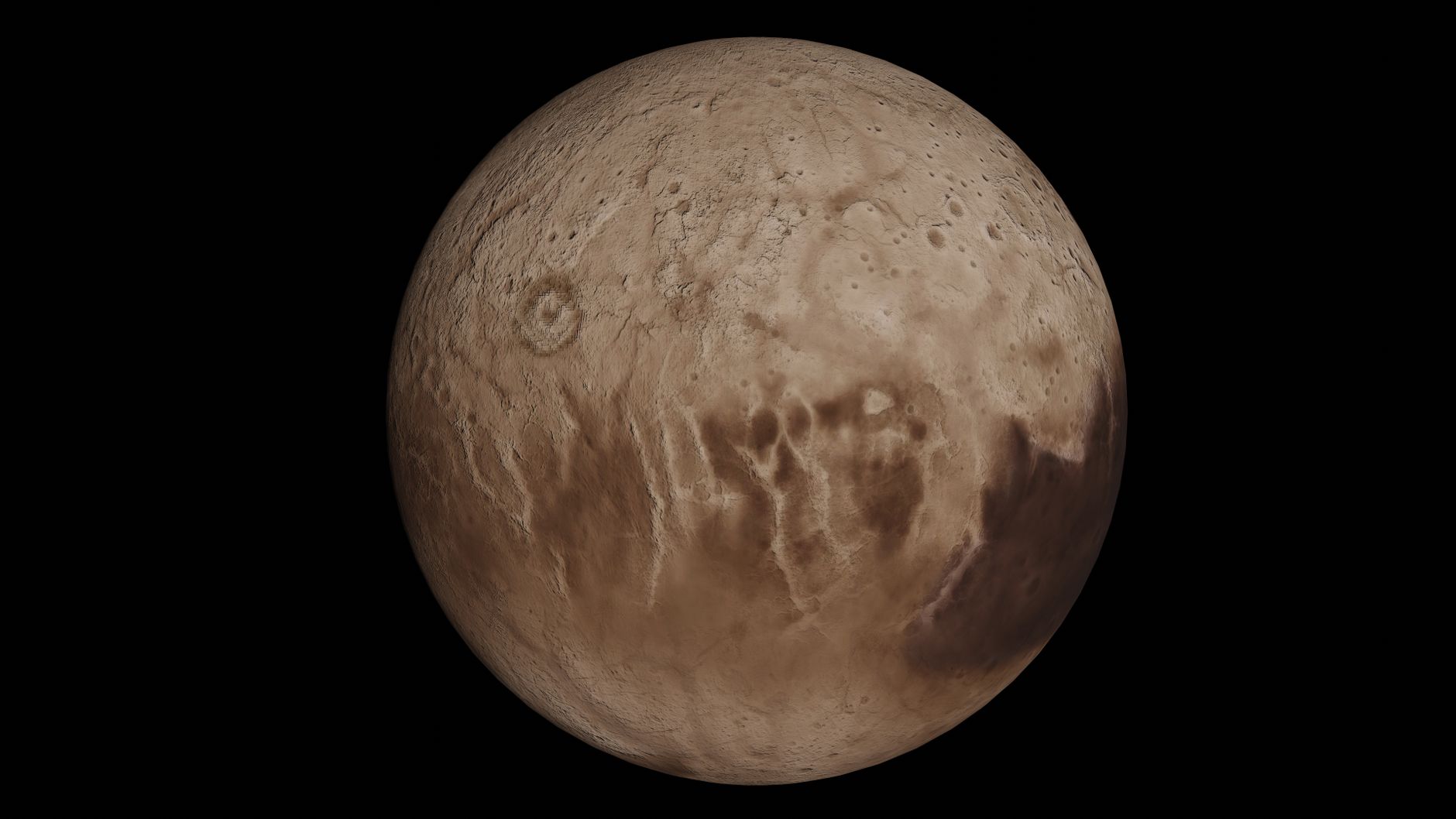
Mars's two moons are among the strangest objects in the solar system. Phobos, the larger, is only 27 × 22 × 18 km — smaller than many asteroids — and orbits Mars closer than any other known natural satellite orbits its parent planet, just 6,000 km above the surface. It completes an orbit every 7 hours and 39 minutes — faster than Mars itself rotates — which means it rises in the west and sets in the east three times per Martian day. Deimos, the smaller and more distant moon, is only 15 × 12 × 11 km. Both moons are dark, irregularly shaped, and heavily cratered. Their composition and origin have been debated for decades, and a Japanese space agency mission called MMX is currently en route to determine once and for all what they are made of — and to bring back the first sample from either moon.
What happened
Phobos and Deimos were discovered in August 1877 by American astronomer Asaph Hall, who searched for Martian moons after Jules Verne and Jonathan Swift had each guessed (correctly, in a stunning coincidence) that Mars had two moons in their fiction. Their properties were puzzling from the start: their orbits are very close to Mars and nearly circular, their surfaces are extremely dark (they reflect only 5-7% of incident light), and spectral analysis suggests they contain carbon-rich material similar to D-type asteroids in the outer asteroid belt.
The asteroid capture hypothesis proposes that Phobos and Deimos were originally asteroids from the outer belt that were gravitationally captured by Mars early in the solar system's history. The challenge is that capturing an asteroid into a stable, nearly circular orbit requires dissipation of enormous amounts of energy — the circumstances under which this could happen naturally are debated and the orbital mechanics are complex.
The giant impact hypothesis proposes that a large body struck Mars early in its history (analogous to the Earth-Moon forming impact), and the debris from the collision coalesced into the two small moons. This would explain their nearly equatorial, circular orbits and their proximity to Mars. The problem is that if they formed from Martian material, their composition should resemble Mars's crust — but spectral observations suggest they look more like asteroid material.
A third possibility — that the moons formed from material captured from a disrupted asteroid or from debris rings of a previous generation of moons — is also considered. The truth may involve a mix of processes.
JAXA's Martian Moons eXploration (MMX) mission, launched in 2024, will orbit Mars and make multiple flybys of Phobos and Deimos before landing on Phobos to collect at least 10 grams of surface material. It will return to Earth in 2029. The sample — even 10 grams — will allow isotopic analysis that should definitively distinguish Martian-derived material from asteroid-captured material.
Why it matters
Phobos's fate is particularly dramatic. It orbits so close to Mars and is losing orbital energy so slowly to tidal dissipation that it is spiraling inward at about 2 cm per year. In roughly 30-50 million years, it will cross the Roche limit — the distance at which Mars's tidal forces overcome Phobos's self-gravity — and either crash into Mars as a single body or disintegrate into a ring of debris. If it forms a ring, Mars will briefly have ring system like Saturn's before the material gradually rains down onto the surface. No spacecraft will be around to see it, but the outcome is more certain than almost any other predicted event in planetary science.
For Mars exploration, Phobos and Deimos are interesting as potential way stations for human missions. A habitat on Phobos, 6,000 km above the Martian surface, would be in low gravity, shielded from some radiation by Mars's magnetic protection (limited as it is), and in continuous view of most of Mars's surface. The Delta-V to get to Phobos from Earth orbit is less than to land on Mars directly, and a Phobos station could support surface operations remotely without the communication delays of Earth-based control.
Understanding the moons' composition is also scientifically important for understanding what material was available in the early inner solar system. If Phobos is captured asteroid material, its composition provides information about the primitive carbon-rich bodies that dominated the asteroid belt before the giant planets rearranged the solar system.
- The MMX sample return will definitively resolve the origin question using the same isotopic tools that resolved the Moon-formation debate — a clean answer to a long-standing mystery.
- Phobos and Deimos are accessible targets with relatively low landing-and-return Delta-V, making them potentially useful staging points for human Mars exploration missions.
- Their unusual orbital and physical properties make them valuable natural laboratories for understanding small body dynamics, tidal evolution, and surface processes in the Martian environment.
- Phobos's extremely low gravity (about 0.0006 g) makes landing and surface operations technically challenging — spacecraft must essentially dock rather than land, and any disturbance could cause equipment to drift away.
- The dark, carbon-rich surface of Phobos makes high-resolution imaging and compositional analysis difficult and requires instrument designs optimized for very low albedo targets.
- Neither moon is massive enough to retain a significant atmosphere or generate internal heat, limiting their potential as self-sustaining habitats compared to larger bodies like the Moon or Mars itself.
How to think about it
The Phobos-Deimos origin question is a nice case study in how science makes progress when the same phenomenon is compatible with multiple hypotheses. The asteroid capture hypothesis and the giant impact hypothesis each explain some observations while struggling with others. The resolution requires data that distinguishes between them definitively — specifically, isotopic ratios that would differ between Martian-derived and asteroid-derived material. MMX is designed to provide exactly that data.
The countdown to Phobos's eventual destruction is also a useful reminder of how dynamic the solar system actually is on geological timescales. The moons of Mars are temporary. If the giant impact hypothesis is correct, a previous generation of moons — perhaps larger and more dramatic — formed and then gradually spiraled in and were destroyed billions of years ago. The current Phobos and Deimos may themselves be second-generation objects. On timescales of hundreds of millions of years, the solar system is not the stable clockwork it appears on human timescales.
FAQ
Why does Phobos have such a large crater relative to its size?+
Have any spacecraft landed on Phobos?+
Could humans ever live on Phobos?+
- astronomy·5 min readSeismic Data Reveals Ancient Magma Oceans on Mars, Hinting at Broader Habitable Conditions
NASA's InSight mission data suggests Mars once harbored vast magma oceans beneath its crust. This discovery challenges assumptions about planetary habitability and tectonic activity.
- astronomy·7 min readThe Giant Impact Hypothesis and How the Moon Was Born
The Moon is unusually large for a rocky planet's companion, shares Earth's orbital plane, and is remarkably similar in composition to Earth's outer layers. The leading explanation is violent: a Mars-sized body called Theia struck the young Earth.
- astronomy·7 min readHow Our Solar System Formed from a Collapsing Molecular Cloud
About 4.6 billion years ago, a cloud of gas and dust in the Milky Way collapsed under its own gravity, forming the Sun and a spinning disc of material that eventually became every planet, moon, and asteroid in the solar system.