How Our Solar System Formed from a Collapsing Molecular Cloud
About 4.6 billion years ago, a cloud of gas and dust in the Milky Way collapsed under its own gravity, forming the Sun and a spinning disc of material that eventually became every planet, moon, and asteroid in the solar system.
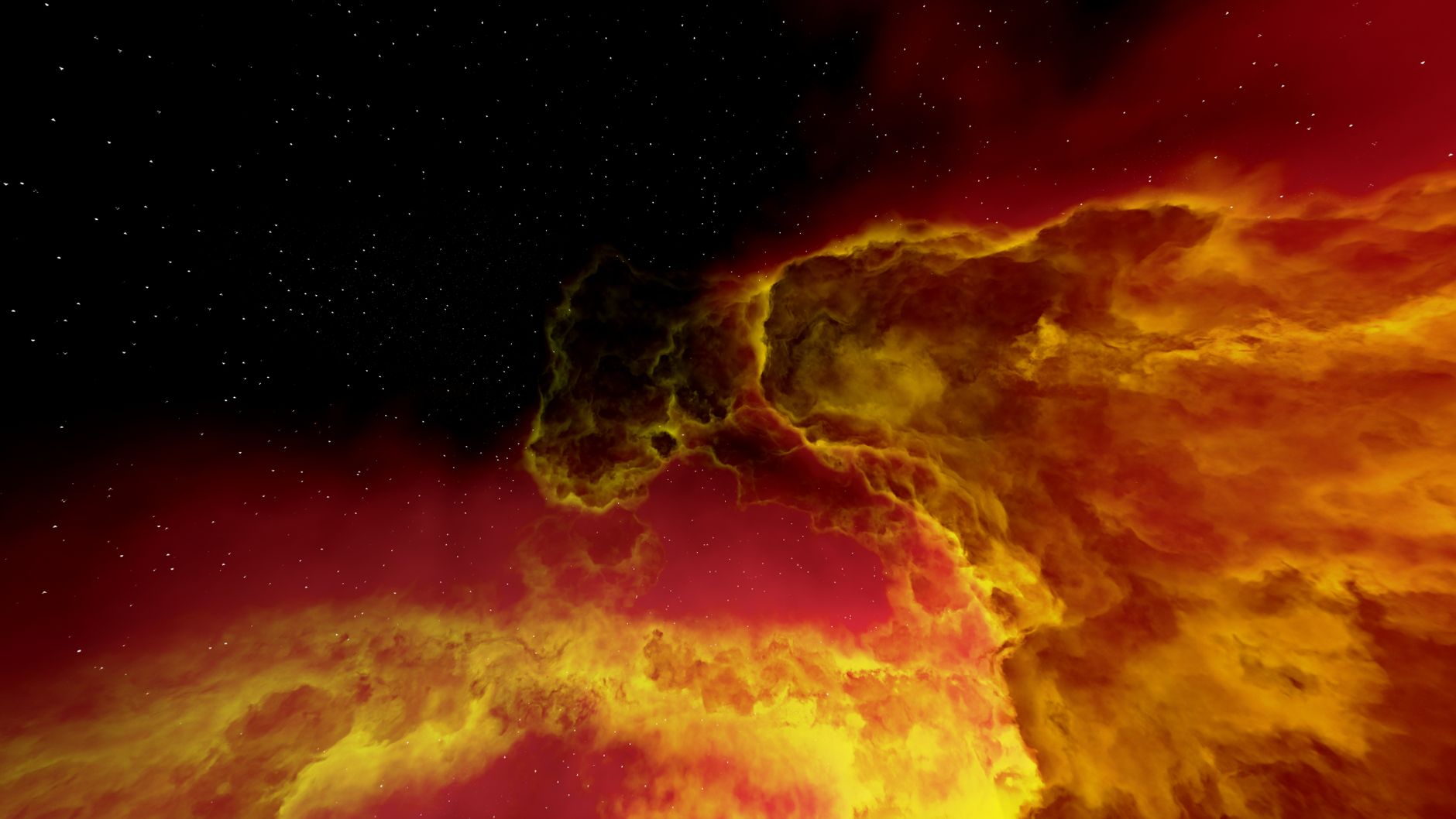
The solar system did not spring into existence fully formed. It assembled itself over millions of years through a chain of physical processes beginning with the collapse of a cloud of gas and dust and proceeding through the accumulation of dust grains into pebbles, pebbles into planetesimals, and planetesimals into planets. The evidence for this history is encoded in the ages of meteorites (the oldest of which date to 4.568 billion years), the compositions of solar system bodies, the orbital architecture of the planets, and — in the past few decades — direct observations of other protoplanetary disks around young stars throughout the Milky Way. The solar system is not unique: it is one instance of a process that plays out billions of times across the galaxy.
What happened
The nebular hypothesis for solar system formation has its roots in the 18th century — Immanuel Kant and Pierre-Simon Laplace both proposed that the Sun and planets condensed from a rotating cloud of gas. The modern version, developed through the 20th century, is more detailed and observationally grounded.
The initial collapse was triggered by some disturbance — perhaps a nearby supernova whose shockwave compressed the cloud beyond the critical density at which gravity overcomes thermal pressure. As the cloud collapsed, it began to rotate faster (conservation of angular momentum, the same reason ice skaters spin faster when they draw their arms in). The collapse along the rotation axis was faster than along the equatorial plane, so the cloud flattened into a rotating disk — the protoplanetary disk or solar nebula — with a hot dense center where the proto-Sun formed.
The proto-Sun gathered most of the mass (the Sun contains 99.86% of all the mass in the solar system). In the disk around it, temperature and pressure varied with distance: close to the Sun, conditions were hot enough that only silicates and metals could condense as solid grains; farther out, beyond the "snow line" at roughly 3 AU, water ice and other volatile ices could also condense. This temperature gradient is why the inner solar system has rocky planets and the outer solar system has giant planets — the availability of solid material to accrete was much greater beyond the snow line.
Dust grains stuck together through electrostatic forces and grew into centimeter-sized aggregates. The growth from centimeters to kilometer-sized planetesimals is one of the least understood steps — there is a "meter-sized barrier" where particles are large enough to experience destructive collisions before they can gravitationally attract each other, and explaining how planetesimals formed despite this barrier is an active area of research. Once planetesimals existed, gravitational interactions caused them to accumulate into planetary embryos, and then into the full-sized planets through giant impacts over tens of millions of years.
Why it matters
Understanding solar system formation is foundational to understanding how common Earth-like planets are, what determines whether a planet is habitable, and what the solar system's future will look like. The same processes play out around other stars, and the Atacama Large Millimeter Array (ALMA) has now imaged dozens of protoplanetary disks around young stars, revealing rings, gaps, and asymmetries that show planet formation already underway.
The chemical abundances in the solar system — the ratios of carbon to oxygen, of silica to iron, of short-lived radioactive isotopes — constrain both the conditions in the proto-solar nebula and the history of the galaxy at the time of solar system formation. The presence of short-lived isotopes like aluminum-26 in the oldest meteorites implies the solar system formed from material recently enriched by a nearby supernova — possibly the very event that triggered the cloud's collapse.
For astrobiology, the architecture of the solar system is not random. Jupiter's presence in the outer solar system likely redirected many comets and asteroids inward, delivering volatiles to the inner planets (including Earth's water) while also shielding the inner solar system from some bombardment. Understanding why our solar system has this configuration — and how common similar configurations are around other stars — is central to assessing how common habitable planets are.
- The nebular hypothesis is strongly confirmed by direct imaging of protoplanetary disks around other young stars, which show structures consistent with planet formation in progress.
- Meteorite dating provides exquisitely precise constraints on the timeline of solar system formation, confirming the basic chronology of the model.
- The model naturally explains major features of the solar system: the ecliptic plane, planetary rotation directions, the composition gradient from rocky inner planets to icy outer bodies.
- The "meter-sized barrier" problem — how dust aggregates grow past centimeter scales to gravitationally bound planetesimals — is not fully solved.
- The late heavy bombardment around 4 billion years ago suggests major dynamical instabilities in the early solar system not fully captured by the simplest formation models.
- The origin of the solar system's water — whether delivered by comets, asteroids, or accreted from the nebula — remains debated.
How to think about it
The most clarifying frame for solar system formation is thinking about it in stages, each governed by a different dominant force. Stage one is gravitational collapse of the molecular cloud, governed by gravity overcoming thermal pressure. Stage two is disk formation and evolution, governed by angular momentum conservation and viscous transport of matter inward. Stage three is planetesimal formation, governed by aerodynamics and electrostatics in the first step, then gravitational collapse. Stage four is planetary accretion, governed by gravitational scattering and giant impacts. Each stage has a characteristic timescale: collapse takes about 100,000 years; disk evolution, millions of years; terrestrial planet formation, tens of millions of years.
The fact that we can observe these stages in other star systems — not just reconstruct them from our own solar system's archaeological record — is one of the great advances of modern astronomy. ALMA images of protoplanetary disks show structures (rings, gaps, spiral arms) that can be matched to models of planet-disk interaction, allowing astronomers to infer where planets are forming even when the planets themselves are not yet detectable.
The solar system as we know it is also not the end state of formation — it is still evolving. The Moon is slowly receding from Earth; planetary orbits precess; the solar system will eventually interact gravitationally with passing stars on timescales of billions of years. Formation is a process, not an event.
FAQ
How do we know how old the solar system is?+
Why do all the planets orbit in roughly the same plane?+
Where did Earth's water come from?+
- astrophysics·4 min readAncient Meteorite Unveils Evidence of a Lost Protoplanet from Early Solar System
A recent meteorite analysis has revealed compelling evidence of a moon-sized protoplanet that existed in the early solar system, offering new insights into planetary formation.
- astronomy·3 min readVLT captures black hole Swift J1727.8−1613 outburst, revealing jets that expel most of the accreted gas
VLT observations of Swift J1727.8−1613 show that a black hole can eject most of the gas it accretes, reshaping ideas of black‑hole feeding.
- astronomy·5 min readSeismic Data Reveals Ancient Magma Oceans on Mars, Hinting at Broader Habitable Conditions
NASA's InSight mission data suggests Mars once harbored vast magma oceans beneath its crust. This discovery challenges assumptions about planetary habitability and tectonic activity.