Space Weather and Auroras: How the Sun Shapes Our Magnetic Shield
The Sun constantly streams charged particles past Earth at hundreds of kilometers per second. When disrupted by solar flares or coronal mass ejections, this stream produces auroras, disrupts satellites, and in extreme cases can knock out power grids.
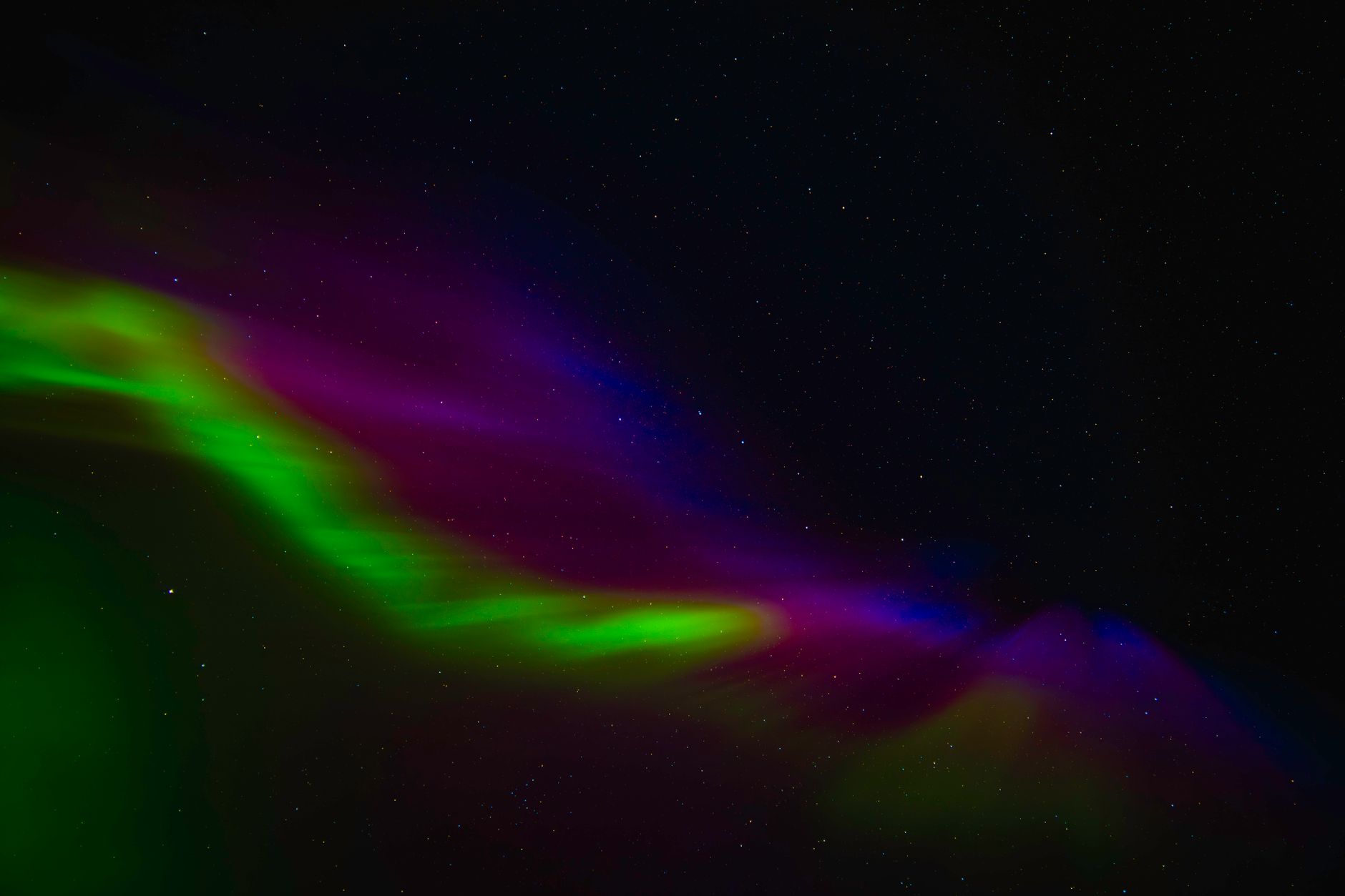
Every second, the Sun expels roughly a million tonnes of charged particles — a stream of electrons, protons, and helium nuclei called the solar wind — at 400 to 800 kilometers per second. Earth sits in that wind and is constantly buffeted by it. What protects us is Earth's magnetic field: it deflects most of the solar wind around the planet, creating a vast magnetosphere that extends tens of thousands of kilometers into space. This interaction is not gentle. The Sun occasionally erupts in solar flares — sudden bursts of X-rays and ultraviolet radiation — or launches coronal mass ejections (CMEs), billion-tonne clouds of magnetized plasma hurled across the solar system at millions of kilometers per hour. When these events hit Earth's magnetosphere, the effects range from the spectacular (auroras visible across continents) to the catastrophic (geomagnetic storms that damage power grids and disable satellites).
What happened
The term "space weather" became scientifically formalized in the 1990s, but the phenomenon was recognized much earlier. In September 1859, a massive solar flare and CME struck Earth — the Carrington Event — and produced auroras visible at tropical latitudes and set telegraph systems on fire. The storm's induced currents disrupted telegraph networks across Europe and North America, in some cases shocking operators and setting paper on fire.
The same event today would be far more disruptive. Modern civilization runs on electrical infrastructure that the 19th century did not have: satellite networks for GPS, communication, and weather prediction; high-voltage power transmission lines that act as antennas for geomagnetically induced currents; internet infrastructure; precision navigation for aircraft. A Carrington-scale event is estimated to cause trillions of dollars of damage and take months or years to repair.
Lesser but still significant events occur regularly. In March 1989, a CME-driven geomagnetic storm knocked out the Hydro-Québec power grid in Canada for nine hours, leaving six million people without electricity. In 2003, the Halloween storms disrupted spacecraft operations, caused aviation rerouting, and degraded GPS accuracy. In May 2024, a series of strong CMEs produced auroras visible across much of the United States and Europe, the most widespread auroral display in decades.
NOAA's Space Weather Prediction Center (SWPC) in Boulder, Colorado, provides real-time monitoring and forecasts using data from solar observatories, the DSCOVR satellite at the L1 point (which provides about 15-60 minutes warning of incoming CMEs), and ground-based magnetometers. The limiting factor in space weather forecasting is predicting the orientation of a CME's magnetic field — if it is aligned to connect with Earth's field, the resulting geomagnetic storm is far more severe. This orientation is often not known until DSCOVR measures the CME right at Earth's doorstep.
Why it matters
Practical space weather preparedness is one of the more under-resourced areas of national security and critical infrastructure protection. Power grid operators, satellite operators, and aviation authorities have begun integrating space weather forecasts into operations, but the industry's readiness is uneven. A major geomagnetic storm could destroy large power transformers that take months to manufacture and replace, causing cascading grid failures. A geomagnetic storm of the 1989 Quebec level hitting the US Northeast could plausibly leave millions without power for weeks.
The scientific importance runs deeper. Earth's magnetosphere is a laboratory for plasma physics processes that occur throughout the universe: magnetic reconnection, particle acceleration, wave-particle interactions. Understanding how the magnetosphere responds to the solar wind tests the same physics that governs stellar coronae, accretion disks, and the jets of active galactic nuclei.
For astronauts, space weather is a direct safety concern. Outside Earth's protective magnetosphere — on the Moon, on Mars, or during interplanetary transit — astronaut radiation exposure depends critically on solar activity. Predicting when the Sun will produce major eruptions is essential for mission planning.
- Auroras are among the most spectacular natural phenomena on Earth, visible to millions and inspiring cultures for millennia — space weather has genuine beauty alongside its hazards.
- Space weather research has driven development of space plasma physics, a field with applications ranging from fusion energy to understanding stellar and galactic astrophysics.
- Modern monitoring infrastructure provides hours to days of warning for most significant events, giving grid operators and satellite controllers time to take protective measures.
- Forecasting the magnetic field orientation of an incoming CME — the key parameter for storm severity — remains poor until the cloud is almost upon Earth.
- The power grid vulnerability to geomagnetically induced currents has been known for decades but investment in protective measures remains inadequate in most countries.
- The Sun's 11-year activity cycle makes severe space weather events cluster in time, and the current cycle peaked in 2025 — near-term risk is elevated.
How to think about it
The cleanest mental model for the solar wind-magnetosphere interaction is a boat moving through a river: Earth is the boat, the solar wind is the river current, and the magnetosphere is the bow wave and wake. The magnetosphere is not a static shield but a dynamic, constantly changing structure that responds to variations in the solar wind — compressed on the sunlit side, stretched into a long tail on the night side, and punctured by magnetic reconnection events that allow solar wind particles to penetrate.
Auroras are the visible signature of this connection: charged particles channeled along field lines into the polar regions, colliding with oxygen and nitrogen in the upper atmosphere and exciting them into glowing sheets of green, red, and purple light. The green comes from oxygen at about 100 km altitude; the red from oxygen higher up; the purple and blue from nitrogen. The curtain-like forms reflect the structure of the field lines guiding the particles in.
Space weather is sometimes described as a "low-probability, high-consequence" risk — the Carrington-scale event may not happen again for decades or centuries, but when it does the damage will be enormous. The smarter frame is actuarial: the 1-2% per decade probability of a Carrington-class event, multiplied by the projected damage, justifies significant investment in preparedness regardless of the specific timing. The Sun will eventually produce another extreme storm. The only question is whether civilization will be ready.
FAQ
What causes the different colors of the aurora?+
How much warning would we have before a major geomagnetic storm?+
Could a major geomagnetic storm knock out the internet?+
- astronomy·3 min readChang'e-6 Samples Show Earth's Magnetosphere Slows Solar Wind on Moon's Near Side
Analysis of Chang'e-6 lunar regolith reveals Earth's magnetosphere reduces solar‑wind speed on the Moon's near side, leaving distinct noble‑gas signatures.
- astronomy·4 min readSun Unleashes Barrage of Flares and CMEs, Sparking Hopes for Widespread Aurora Displays
The Sun has fired off numerous solar flares and Earth-directed CMEs, increasing the likelihood of G1-G2 geomagnetic storms. Aurora chasers could see enhanced northern lights, potentially visible in…
- news·4 min readNorthern Lights Forecast: Geomagnetic Storm Offers Rare Visibility Across Northern US States
A coronal mass ejection from the sun is set to trigger a G1/G2 geomagnetic storm, potentially making the Northern Lights visible in up to 19 northern US states. Learn when and where to look for this…