New HI Observations Reveal Hidden Cavity and Structures in the Extended Orion Nebula
Radio maps from the VLA and FAST uncover a previously unknown cavity in the Extended Orion Nebula, reshaping our view of star‑forming environments.
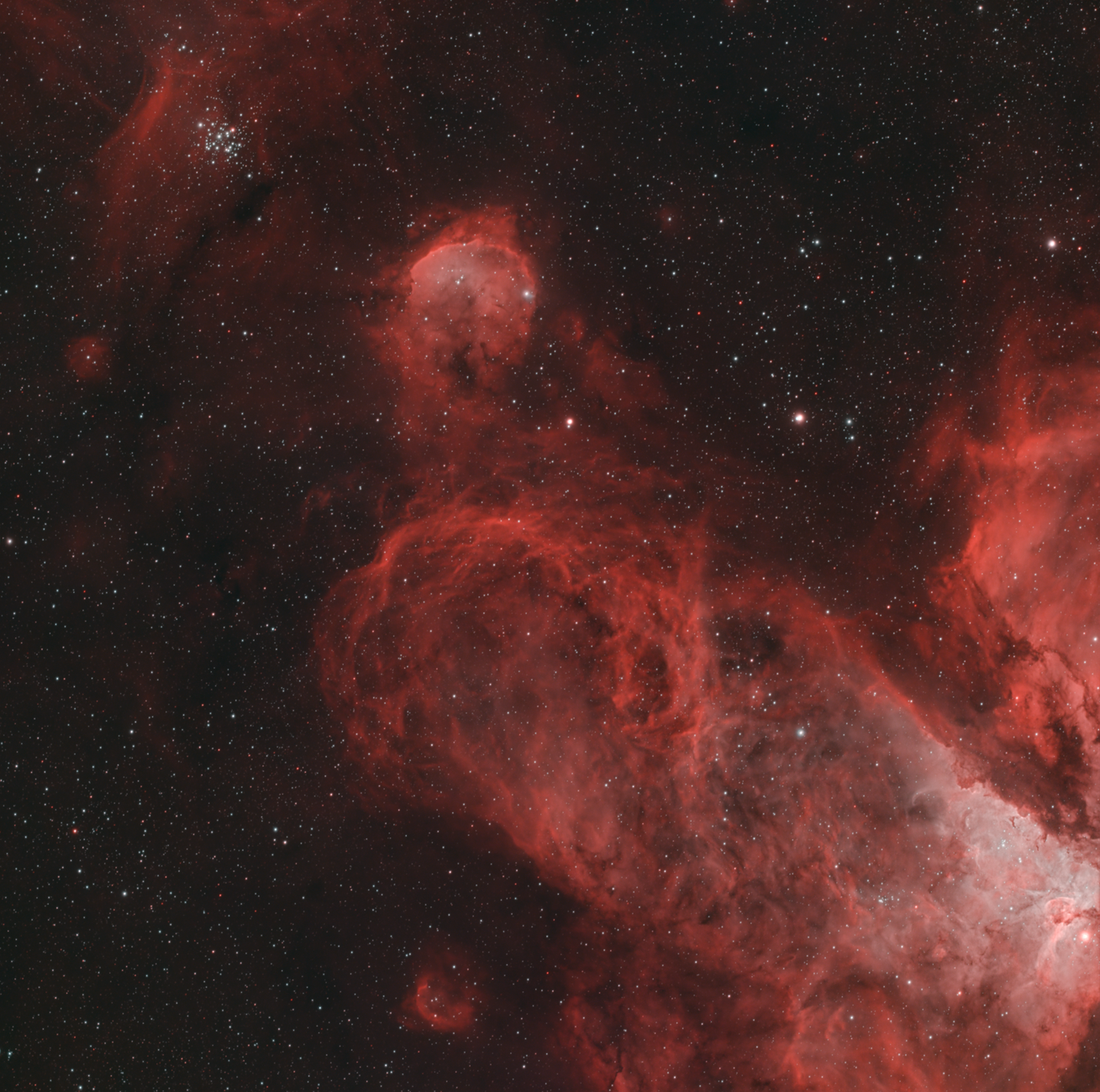
The Orion Nebula has dazzled observers for centuries, but its larger envelope—the Extended Orion Nebula (EON)—has kept many of its secrets hidden. A new study using neutral atomic hydrogen (HI) maps from the VLA and the Five‑hundred‑meter Aperture Spherical Telescope (FAST) has uncovered a distinct cavity and several filamentary structures within the EON. These features do not match the imprint of a supernova explosion, suggesting a different sculpting mechanism. Because HI traces the raw material that will soon become molecular gas, the discovery reshapes how we view the early stages of star formation in our nearest massive stellar nursery.
What happened
The research team, led by Juan Diego Soler, combined interferometric data from the Karl G. Jansky Very Large Array with single‑dish observations from FAST to produce the most detailed HI map of the Orion region to date. The 21 cm emission revealed a roughly spherical void, about a few parsecs across, embedded in the EON and surrounded by thin, arc‑shaped filaments. In addition to the cavity, the map identified several previously unseen density enhancements that align with known infrared knots, allowing a more precise measurement of their HI column density.
Why it matters
The cavity demonstrates that stellar winds, radiation pressure, or collective outflows from the Trapezium cluster can evacuate neutral gas without the need for a supernova blast. This challenges the conventional view that supernovae dominate feedback in massive star‑forming regions and suggests that earlier, gentler processes may set the initial conditions for subsequent star formation. Understanding these mechanisms refines models of how gas cycles from atomic to molecular phases, directly impacting predictions of star‑formation rates in galaxies.
- Provides the highest‑resolution HI view of the Orion complex.
- Reveals feedback processes that operate before the first supernova.
- Shows the power of combining interferometer and giant single‑dish data.
- HI alone cannot trace the dense molecular cores where stars actually form.
- Interpretation of the cavity’s origin remains model‑dependent.
- Limited sky coverage; similar features may be missed elsewhere.
How to think about it
When evaluating feedback in star‑forming regions, start by mapping the neutral atomic component before moving to molecular tracers. Compare the size and energy budget of any cavities with the known output of nearby massive stars to assess whether winds or radiation could be responsible. Finally, integrate the HI results with infrared and CO data to build a multi‑phase picture of gas evolution.
FAQ
What does the HI 21 cm line tell us about star formation?+
Why can’t the cavity be caused by a supernova?+
Will similar cavities be found in other nebulae?+
- astronomy·3 min readJuly 2026 Report: Long‑Lived Exoplanet Atmospheres, Extended Star Birth, and a Quieter Galactic Black Hole
July 2026 findings show exoplanet atmospheres lasting billions of years, star formation persisting longer, and a less ravenous galactic black hole.
- astronomy·3 min readSaturn’s Six Largest Moons Shine in APOD’s August 11 Image – 293 Moons Confirmed
NASA’s August 11 APOD showcases Saturn’s six biggest moons, highlighting the planet’s record 293 confirmed satellites.
- astronomy·3 min readSeven New Quasar‑Lens Systems Discovered Using AI in 800,000 Spectra
Astronomers used AI to sift through 800,000 quasar spectra, uncovering seven new quasar‑lens systems and roughly doubling the known sample.