Fast Radio Bursts: The Deepest Mystery in Modern Astronomy
For a few milliseconds, a fast radio burst releases more energy than the Sun emits in three days. Then it is gone. Astronomers detected the first one in archival data in 2007; by 2020 we had identified hundreds, some of them repeating. We now know they come from across the universe, and in one case from within our own galaxy. We still do not fully understand what makes them.
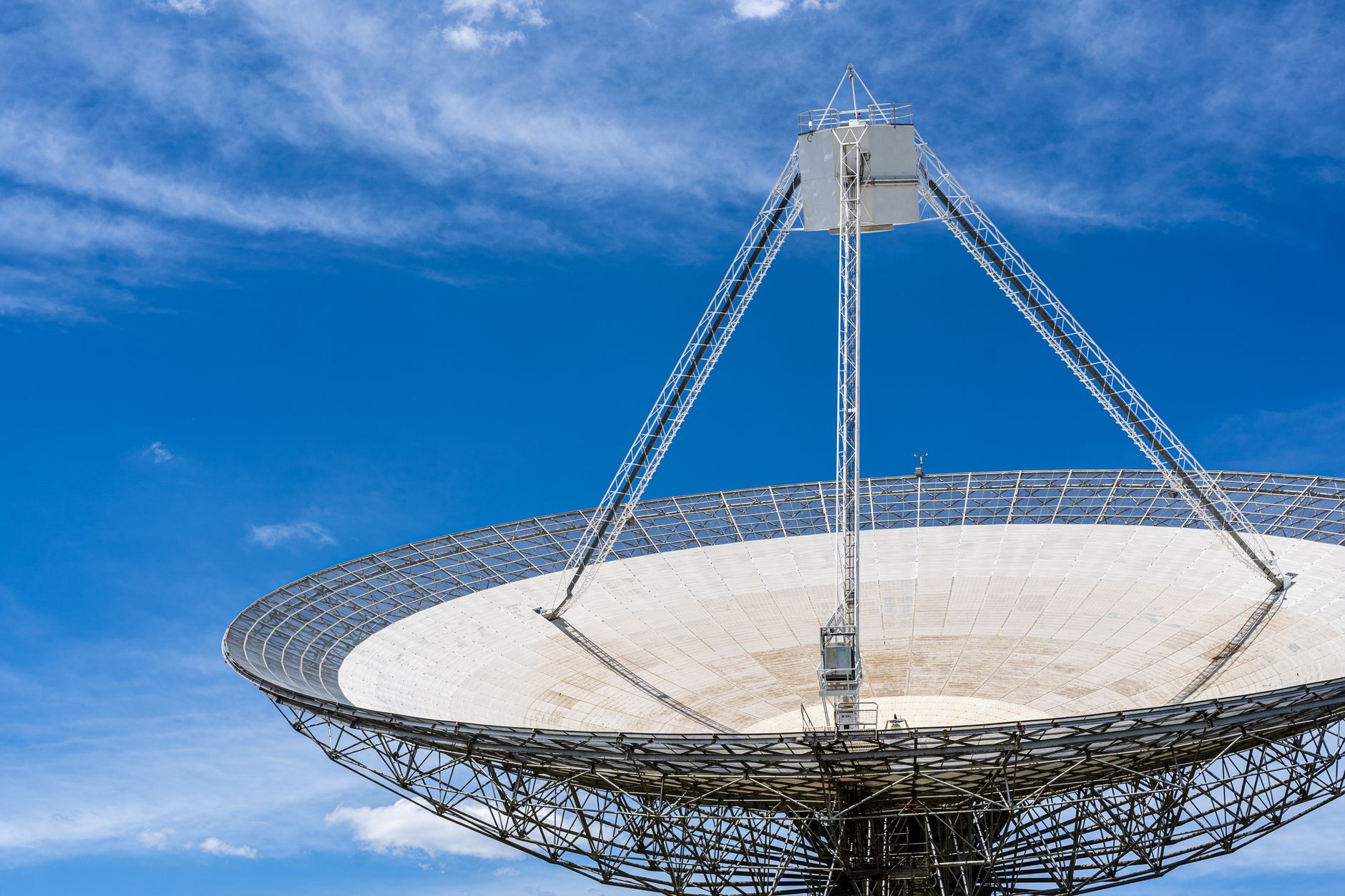
Fast radio bursts are one of the best examples of how the universe can still surprise a data-rich civilization. They are brief, bright, and absurdly energetic flashes of radio emission arriving from far beyond the Milky Way. For years astronomers were not even sure they were real. Now we know they are common, diverse, and potentially useful as cosmic probes. We still do not have a complete theory for what powers them.
What happened
The first FRB was identified in archival Parkes telescope data and initially drew skepticism because one-off transients are notoriously easy to mistake for noise or terrestrial interference. As more events were found, and especially as repeating sources emerged, the case became undeniable. Instruments such as CHIME transformed the field by detecting large numbers of bursts across wide areas of sky, revealing that FRBs are not freak occurrences but a significant astrophysical population.
Several clues now shape the debate. FRBs originate at cosmological distances, which means their brightness temperatures and energy release mechanisms must be extreme. Some repeat irregularly, while others have not been seen to repeat, suggesting there may be multiple source classes or multiple emission modes. A major breakthrough came when a Galactic magnetar, SGR 1935+2154, produced an FRB-like burst, strongly implicating magnetars at least for part of the population.
Yet the mystery is not solved. Different bursts show different polarization behavior, temporal structures, and local environments. Some appear to emerge from highly magnetized surroundings; others do not. The field has moved from Are FRBs real to Which engines make which kinds of FRBs and how can we use them as tools for cosmology.
Why it matters
FRBs matter because they are not only strange objects but also powerful probes. As their radio waves travel through space, they are dispersed by electrons in the intergalactic medium. Measuring that dispersion can help map otherwise hard-to-see baryonic matter between galaxies. In effect, FRBs can illuminate the cosmic web using the universe's own transient flashbulbs.
They also matter because they show modern astronomy operating in real time. A phenomenon unknown to science a couple of decades ago is now a major field linking radio instrumentation, plasma physics, compact objects, and cosmology. FRBs are a reminder that even in the age of precision cosmology, the sky still contains whole categories of surprise.
- FRBs provide a new tool for probing the ionized matter spread through intergalactic space.
- Their diversity opens a rich window into extreme astrophysical environments.
- The field has advanced quickly thanks to new wide-field radio instruments.
- The underlying emission mechanism remains incompletely understood.
- Different FRB populations may require multiple source models, complicating interpretation.
- Localization and multiwavelength follow-up can be difficult for such brief events.
How to think about it
A useful mental model is to treat FRBs like cosmic lightning. They are brief discharges of extreme conditions, not steady lighthouses. That means understanding them requires both population statistics and forensic reconstruction of the environments where they occur. One spectacular burst is interesting; thousands are transformative.
This also shows how discovery science works today. New instruments change what counts as visible, and entire classes of phenomena emerge from the noise. FRBs remind us that astronomy is not just about refining known questions. Sometimes it is about realizing the universe has been asking different ones all along.
FAQ
Are fast radio bursts caused by magnetars?+
Why do astronomers care so much about millisecond flashes?+
Could FRBs be artificial signals?+
- astrophysics·5 min readNearby Black Hole's Persistent Radio Outburst Offers Unprecedented Glimpse into Early Universe Processes
Astronomers discovered a nearby black hole emitting a long-lasting radio outburst, mirroring conditions in the early universe. This unique event provides a close-up view of black hole growth and jet…
- astrophysics·5 min readLong-Lived Radio Outburst from a Nearby Black Hole Offers Glimpse into the Early Universe
Astronomers have discovered a unique, long-lasting radio outburst from a black hole in the galaxy SDSS J110546.07+145202.4. This rare event provides a close-up 'laboratory' to study conditions akin…
- astrophysics·5 min readBlack Holes' Delayed Radio Burps Reveal Messy Eating Habits After Stellar Feasts
Astronomers discovered that supermassive black holes 'burp' radio waves months or years after devouring a star, revealing their messy eating habits. These delayed outbursts offer new insights into…